
Smart City Operators
Urban sensing with privacy-aware edge processing
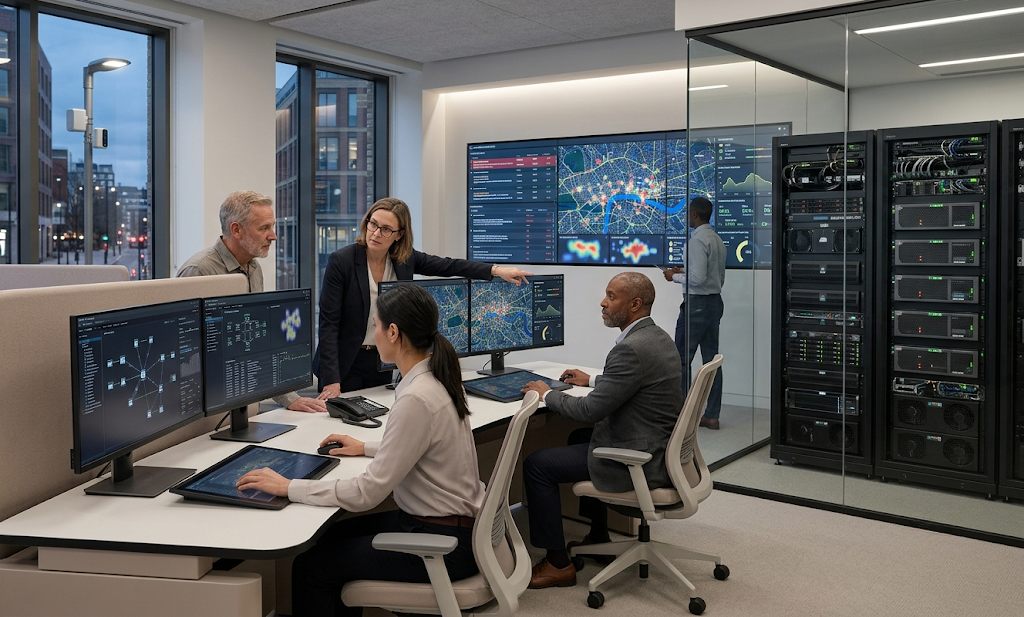
Traffic analytics, public safety assist, and environmental monitoring deployed on street-level edge nodes.
“The most privacy-respecting video pipeline is the one where the video never leaves the pole.”
Smart city operators deploy thousands of cameras and IoT endpoints across districts, traffic intersections, transit corridors, public plazas, and utility corridors. The instinct of a previous technology generation was to backhaul everything to a central video wall. That approach is expensive, slow, and increasingly untenable: uploading raw video city-wide consumes enormous bandwidth, and centralized retention of street footage raises legitimate privacy and governance concerns from residents and councils alike.
Edge AI inverts the architecture. Video and sensor streams are processed locally on street-level edge nodes, counting vehicles and pedestrians, detecting incidents, measuring air quality and noise, and only structured, anonymized insights travel upstream. A camera becomes a sensor that reports twelve westbound vehicles and one stalled car in lane two, not a surveillance feed.
What cities actually deploy
Traffic management leads adoption. Adaptive signal timing driven by real-time counts reduces congestion and idling emissions measurably, and the same detections feed long-range planning models that previously relied on week-long manual counts. Transit agencies layer on dwell-time analytics and platform crowding estimates; public works teams add road-surface condition monitoring from vehicle-mounted cameras.
Public safety applications are deliberately narrower and more accountable at the edge: detecting a wrong-way driver, a pedestrian in a restricted tunnel, or flooding at an underpass, events that trigger immediate operational responses. Because analysis happens locally and raw footage is discarded or held briefly on-device, cities can offer residents concrete technical guarantees about what is and is not retained.
The multi-vendor, multi-agency reality
Municipal technology estates are accumulations of procurement cycles: cameras from three vendors, environmental sensors from two more, and edge enclosures installed across a decade. Aerbix helps municipal technology teams standardize deployments across this heterogeneity, one management plane for model rollout, device health, and configuration regardless of the hardware underneath.
Governance is equally structural. Transportation, police, environmental services, and third-party integrators each need different access to different capabilities. Role-based access control enforces those boundaries in software, while audit logs record every model change and data access, the evidence base a city needs when a council or ombudsman asks how the system is governed.
Operating at street scale
The economics of smart city programs are won or lost on truck rolls. Dispatching crews to update software in every pole-mounted enclosure destroys the business case; over-the-air management of models, firmware, and configuration keeps thousands of nodes current from a single operations center, with staged rollouts and automatic rollback protecting critical intersections from bad updates.
Cities that get this right treat edge infrastructure as a long-lived civic asset: deployed once, improved continuously, and governed transparently. That is the operational foundation on which genuinely responsive urban services get built.
The payoff compounds over time. Each intersection that reports structured traffic events, each corridor that measures its own air quality, and each transit platform that understands its own crowding becomes an input to better planning decisions, shorter commutes, cleaner air, and public services that respond to conditions in minutes rather than budget cycles. Edge AI is the quiet infrastructure that makes that responsiveness affordable.
Discuss this deployment
Our solutions team helps map Aerbix to your fleet, licensing model, and integration requirements.
Talk to Aerbix