Robotics Developers
Ship perception and control stacks that survive the real world
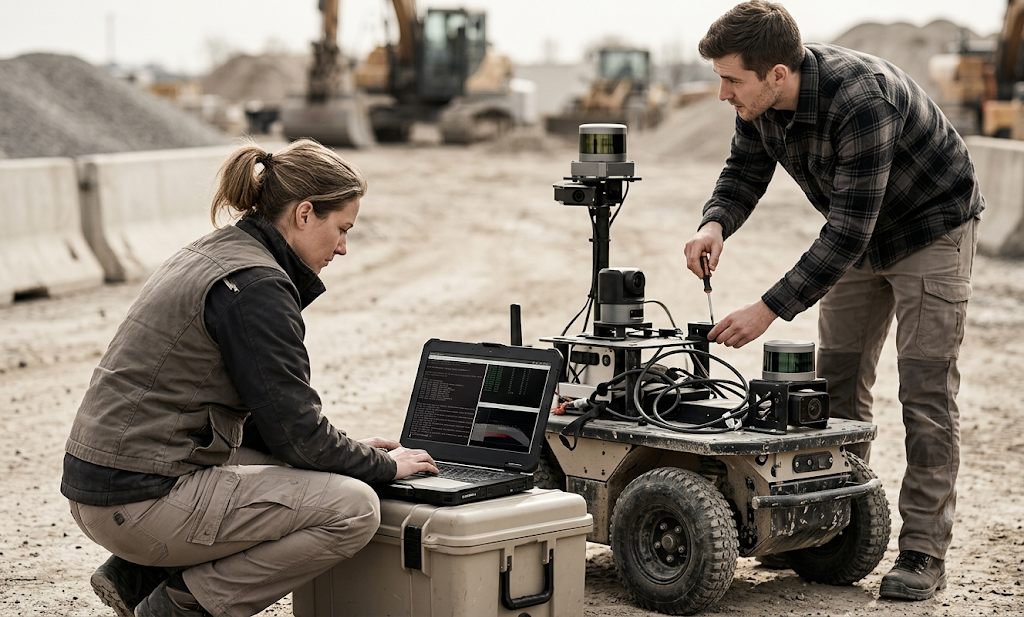
Embedded inference pipelines for manipulation, navigation, and human-robot collaboration on heterogeneous robot hardware.
“The robot that demos well in the lab and the robot that survives a warehouse are separated by deployment discipline.”
Robotics developers juggle ROS nodes, custom drivers, sim-to-real gaps, and hardware that changes every product generation. A perception stack that performs beautifully in a controlled lab collapses when it meets glare from skylights, dust on lenses, unexpected pallet wrap, or a human stepping into the workspace at exactly the wrong moment. Building the model is only half the job, shipping it reliably to hundreds of robots in the field is the other half, and it is the half most teams underestimate.
Aerbix provides a deployment layer that packages optimized models for Jetson, x86 edge boxes, and vendor-specific accelerators, with over-the-air updates when you improve a policy or swap a sensor suite. Whether you build autonomous mobile robots, collaborative arms, or field robots for agriculture and construction, the platform handles model lifecycle, rollback, and fleet-wide configuration so your team can focus on behaviors rather than brittle deployment scripts.
The heterogeneity problem
Few robotics companies enjoy the luxury of a single hardware target. A product line might span three generations of compute modules, each with different memory budgets, accelerator instructions, and thermal envelopes. Maintaining hand-tuned builds for every variant burns engineering time that should go into autonomy improvements.
Aerbix treats compilation targets as first-class configuration. You register a model once, and the platform produces optimized artifacts per hardware profile, quantized where the accelerator demands it, with runtime parameters matched to each device class. When a new compute module enters the lineup, you add a profile rather than forking a pipeline.
From lab to fleet
The promotion path matters as much as the model itself. Export from your training stack, compile for target hardware, push to a staging cohort of robots, validate in the field against live telemetry, then promote to production, all with versioned artifacts and audit trails suitable for safety-conscious robotics programs. If a new grasping policy shows a regression in cycle time or an uptick in intervention rates, rollback is a single action, not a late-night SSH session across a customer's warehouse.
Field validation deserves emphasis. Simulation closes much of the gap, but the long tail of real-world conditions, reflective floors, seasonal lighting shifts, new SKU geometries, only appears in production data. Aerbix streams inference metrics and edge-case captures back from staging robots so your team sees exactly where a policy struggles before it reaches the whole fleet.
Operating at customer sites
Robots increasingly live on networks their builders do not control. Customer IT departments impose firewalls, proxy rules, and maintenance windows. Aerbix agents are designed for constrained connectivity: updates resume after interruption, configuration changes queue until devices reconnect, and every action is logged for the compliance reviews that enterprise deployments inevitably trigger.
The result is a robotics organization that ships autonomy improvements weekly instead of quarterly, because deployment stopped being the bottleneck.
Discuss this deployment
Our solutions team helps map Aerbix to your fleet, licensing model, and integration requirements.
Talk to Aerbix